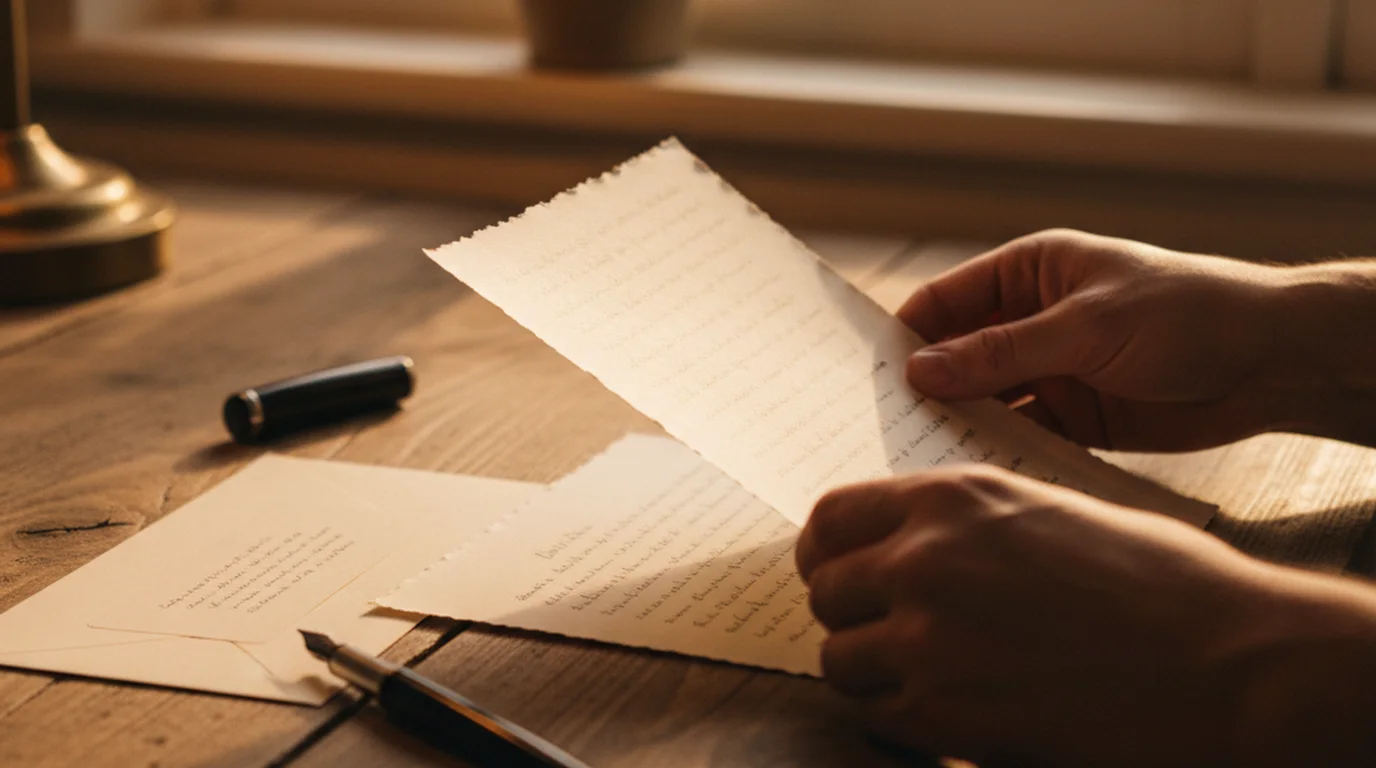

A letter to your future self is one of the few pieces of writing that gets better with age. Written in half an hour on an ordinary evening, it turns into a time capsule: proof of what you worried about, what you hoped for, and how wrong — or right — you were about where life would go.
The method is simple. What makes the difference is what you choose to write about and how you get the letter back.
Quick answer
To write a letter to your future self: pick a date (one year ahead is the classic), describe your life right now in specific detail, write about what's on your mind, ask your future self a few questions, make some predictions, and end with something kind. Then seal it — in an envelope, a scheduled email, or a dated journal entry with a reminder — and leave it alone until the date.
How to write a letter to your future self, step by step
1. Choose when it will arrive. One year is the most common choice and the most reliable: you'll remember writing it, and there's been enough time for real change. Five years suits big transitions. Ten years or more is powerful but riskier to deliver.
2. Set aside 30 minutes somewhere quiet. This isn't a letter to dash off. The details that make it worth reading later only come once you've been writing for a while.
3. Start with today. Date the letter and describe right now: where you're sitting, what you did today, what's on the table. This feels trivial while writing it and is often the part that moves people most when they read it back.
4. Write about three or four things that matter. Work, relationships, health, a decision you're facing, something you're trying to learn. Write about each properly — what's happening, how you feel about it, what you're hoping for — rather than listing twenty things in a line each.
5. Ask questions. Did you take the job? Are you still friends with M.? Did the move feel like the right call? Questions are what turn the letter into a conversation across time.
6. Make predictions. Three or four, specific enough to check. They're the most entertaining part to reread and a lesson in how poorly most of us forecast our own lives.
7. End kindly. Your future self will have lived through things you can't see yet. A warm closing line lands far better than a demand.
8. Seal it and leave it. Resist reading it again before the date. The value comes from the gap.
What to write in a letter to your future self
The difference between a letter that feels flat later and one that hits hard is specificity. "I hope you're happy and healthy" says nothing. "I hope the knee has healed and you're running the river loop again" says everything.
Some topics that work well:
- A normal day, hour by hour. Routines change more than people expect, and an ordinary Tuesday is the thing you'll have no other record of.
- What's worrying you. Most worries resolve or vanish, and seeing them a year later is both a relief and a lesson.
- What you're proud of right now. Small things count.
- The people in your life. Who you see, who you miss, who you're getting to know.
- Prices and details. What rent costs, what's on your phone's home screen, the song you keep playing. Trivial now, fascinating later.
- What you hope will change — and what you hope won't.
- Advice. Not orders. Things you want to remind yourself of.
If you're stuck, set a timer for ten minutes and write about your day without stopping. The material for the rest of the letter tends to surface from that.
Letter to future self examples
Short excerpts to adapt — the value is in swapping in your own details.
A one-year letter:
It's a Sunday in October and the radiator is making that noise again. Right now I'm three weeks into the new job and still can't tell whether I like it or I'm just tired. Question for you: did you stay? Prediction: you'll have stopped taking the 7:40 train because you'll have figured out the cycling route. Be honest — did you?
A five-year letter at a turning point:
You're reading this at 30. I'm writing it at 25, the week we signed the lease on the flat with the green door. I want you to remember how scared we were about money this year, and that it worked out — or if it didn't, that we got through it anyway.
A letter during a hard time:
I don't know what you'll think reading this, but today was a bad one. I'm writing anyway because I want you to know that this version of you kept going. If things are better now, good. If they're not, you've done hard before.
Notice that each one names concrete things — a radiator, a train, a green door. That's what will carry the memory.
How to deliver a letter to your future self
Three options, each with a trade-off:
| Method | Best for | Watch out for |
|---|---|---|
| Sealed envelope marked "Do not open until…" | Long horizons (5–10+ years) | Moving house, losing it, opening it early |
| Scheduled email via a service like FutureMe | 1–5 years, hands-off delivery | Email addresses and services can change over decades |
| Dated journal entry plus a calendar reminder | Keeping it alongside your other writing | Needs a reminder — and the discipline not to read early |
FutureMe has been sending scheduled letters since 2002; a text letter doesn't need its Premium upgrade, which adds images, videos and files. For a letter you want to keep next to the rest of your writing, a dated entry in a journal works just as well — write it on today's page, set a reminder for the date, and the entry is waiting there when it comes round. Our iPhone, iPad and Mac app keeps entries behind a passcode, which helps if part of the appeal is that nobody else reads it first.
Why writing to your future self works
Part of the effect is simply the writing: describing your life and saying what you want next clarifies both, the way self-reflection does.
The other part is about how we think about the future self. Psychologist Hal Hershfield's 2011 review of research on future self-continuity, in the Annals of the New York Academy of Sciences, describes evidence that people make more patient, long-term choices when their future self shares similarities with their present self, is imagined in vivid and realistic terms, and is seen in a positive light. A letter addressed directly to that person is a simple way to make it vivid.
The letter won't change your savings rate on its own. But it does make the person reading it in a year feel less like a stranger. A related practice from manifestation journaling is scripting — writing about the future as if it has already happened — and Manifestly walks through how scripting works.
Write it tonight
A letter to your future self takes about half an hour: today in detail, three or four things that matter, a few questions and predictions, a kind ending. Seal it, set the date, and leave it alone.
The ordinary details are what you'll treasure — so write about the radiator, the train and the song on repeat, not just the big hopes. If you already keep a journal, the letter can live there, waiting on its date like any other entry.

Eleanor Price
The ordinary parts of life are often the ones most worth remembering, reflecting on, and passing down.
Frequently asked questions
Describe your life right now in specific detail — a normal day, what's worrying you, what you're excited about. Then ask your future self questions, make a few predictions, and say what you hope will have changed. End with something kind. Specific, ordinary details are what make the letter moving later; general wishes like "I hope you're happy" read as empty.
Three common ways: an email-scheduling service such as FutureMe, which sends the letter to your inbox on a date you choose; a sealed paper envelope marked "Do not open until" with the date, kept somewhere you'll find it; or a dated entry in a journal app that you set a reminder to reread. Pick based on how far ahead you're writing — services and email accounts can lapse over decades.
Yes. Paper and an envelope cost nothing, and a journal entry with a calendar reminder works the same way. FutureMe, which has been sending letters since 2002, lets you schedule a text letter without its Premium upgrade, which adds images, videos and files.
Two things. Writing it makes you describe your present life and say what you want next, which clarifies both. Reading it later shows you how much has changed, and how accurately you predicted your own future — usually less accurately than expected. Research on future-self continuity suggests that feeling connected to your future self is linked to more patient, longer-term decisions.
One year is the most common and works well: long enough for real change, short enough that you'll remember writing it. Five years suits big transitions — graduation, a move, a new child. Ten years or more is moving to read but carries a delivery risk, because email addresses and services can disappear. For long horizons, paper is the safest option.
One to three pages is typical — long enough for specific detail, short enough to finish in one sitting. A letter that tries to cover everything tends to turn into a list. Pick three or four topics that matter most right now and write about them properly instead of mentioning twenty things in passing.
Something warm and specific. A line of encouragement, a reminder of something you hope you haven't forgotten, or permission to have changed your mind about things. Avoid ending with demands like "you'd better have…" — the person reading it will have lived through things you can't see yet, and a judgmental ending lands badly.