
A new notebook has a strange way of staying empty. It's too nice to waste on a grocery list and too blank to start with a confession, so it sits on the shelf. What usually fills it is not a better prompt but a better page: something with a shape, like a list, a map or a pocket, that tells you what to do with the space.
The 40 journal ideas below are pages, not questions. They come from the notebooks people keep coming back to: collections that grow, memory pages, art journal spreads and small thinking tools. For questions to answer, our 120 journal prompts are the better list.
Quick answer
Good journal ideas are page formats that are easy to start and worth rereading: lists (ten things, "currently"), running collections (quotes, overheard lines), memory pages (a map, a menu), art journal spreads (colour swatches, collage) and thinking pages (decision logs, predictions). Pick one quick page and one recurring page to begin.
Journal ideas that fill a page in ten minutes
These are the openers. Each gives the page a structure so the first entry is easy, which matters more than the idea itself when a notebook is new.
- The "currently" page. Reading, listening to, eating, watching, wearing, worrying about, looking forward to. One line each. Repeat it every few months and the set becomes a quiet record of how you change.
- Ten things in this room. Write them down, then a line on where three of them came from. Objects carry stories you'd never think to write otherwise.
- Top five lists. Comfort foods, walks, songs for a bad day, best gifts received, worst haircuts. Ranking forces a small decision, which is what makes the list interesting to reread.
- Things that went right today. Not gratitude in the formal sense, just small mechanical wins: the bus was on time, the sauce didn't split.
- A day as headlines. Write today as five newspaper headlines, from front page to the small print. It's quick, funny, and surprisingly honest about what mattered.
- A day in numbers. Steps, coffees, emails, minutes outside, pages read. Numbers are a fast entry for days you don't want to describe.
- A packing list for a life you want. What would you take to the place you'd most like to be living in five years? It's a gentle way of writing about goals without a goals page.
- Twenty questions you'd like answered. Anything from "why do cats knead" to "what would I do with a free year". Some of them become entries later.
Collections that grow for months
Collections are the pages that make a journal worth keeping, because they get better every time you add to them. Start one, give it a double page, and add whenever something fits. Planning-style collections like meal plans and project pages are in our bullet journal ideas; these are the reflective kind.
- Overheard lines. Real sentences from strangers, colleagues, children. Five words of dialogue capture a place better than a paragraph of description.
- Quotes with a reply. Copy a line you liked and write one sentence back to it: agreeing, arguing, adding. This is the core of a commonplace book, and the reply is what makes it yours.
- Words worth keeping. New words, family words, words a child mispronounced. Date each one.
- First times. First swim of the year, first time cooking a dish, first conversation with a neighbour. A running first-times list turns ordinary years into something with landmarks.
- Compliments received. Write them down the day they happen, with who said it. On a bad week it's the most useful page in the book.
- Small luxuries under five dollars. Good bread, fresh flowers, a library book. A cheap list that keeps reminding you how little a decent day costs.
- Things you changed your mind about. Foods, people, opinions, habits. A short line on why each one changed.
Memory pages for the details that fade first
Memory fades in a predictable order: dialogue and prices go first, then the weather and the music, while the general outline lasts. Memory journal ideas work best when they aim at the fragile details.
- Map of a place. Draw your street, your childhood house, or the neighbourhood of a trip, and label it with what happened where. Maps pull out memories a paragraph won't.
- A meal, written up. Who was there, what was served, what someone said over it. Dinners are where a lot of family history quietly happens.
- The soundtrack. Songs tied to a season, each with one line about where you heard it.
- What things cost. Rent, a coffee, a bus fare, today's groceries. In ten years this page is fascinating.
- A normal Tuesday, hour by hour. The most ordinary day is the one you'll remember least and want most later.
- Letter to a younger self. A page addressed to you at fifteen, with what you know now. The reverse, a letter to your future self, makes a good companion page.
- One photo, fully described. Stick in a photo and write what's outside the frame: what happened before and after it was taken.
Art journal ideas for people who can't draw
Art journal pages do not need skill. They need a constraint, so the page has a finish line instead of a blank expectation. Use paper that can take a little water, or pick dotted or grid paper and stick to pencil and pen.
- Colour of the day. A single swatch of paint, pencil or a paper scrap, with one line about why that colour. A month of them makes a striking spread.
- Contour drawing of your hand. Draw it without looking at the paper. It's meant to look odd, and the oddness takes the pressure off every page after it.
- Collage from the recycling. Cut shapes out of packaging, labels and envelopes and glue down a scene from your week. This is where art journaling meets the junk journal.
- Washi tape weather. One strip per day across a page, choosing tape or a paper scrap that matches the weather.
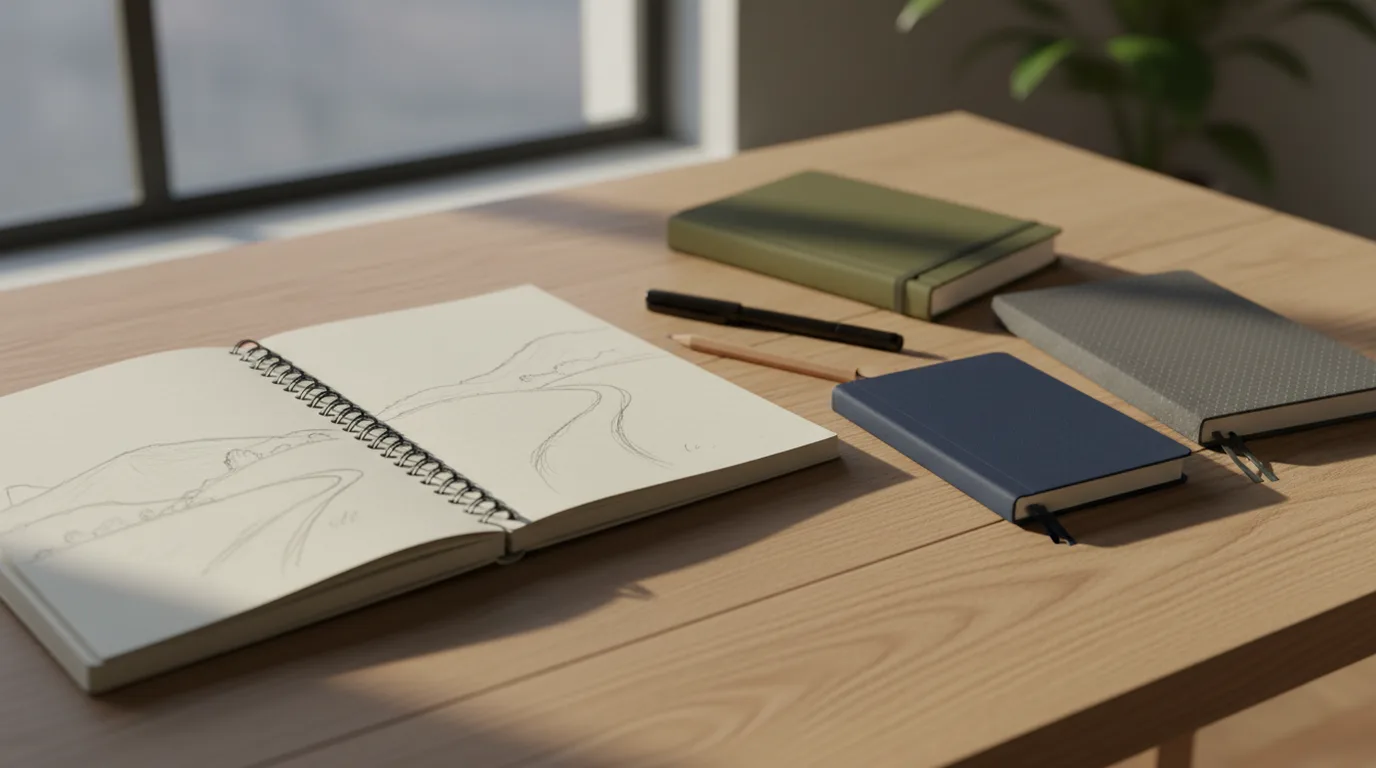
- Labelled still life. Sketch three objects on your desk and label them with arrows and small notes. The labels carry the writing, the sketch carries the mood.
- Blackout page. Take a page from an old book or magazine and black out everything except a few words that form a sentence. Glue it in and date it.
- One-line-a-day doodle. A thumbnail sketch of the day's main moment, the size of a postage stamp. Small enough to do every night.
Interactive pages: pockets, flaps and tuck spots
These come straight out of junk journaling, and they solve a real problem: where to put the paper your week produces.
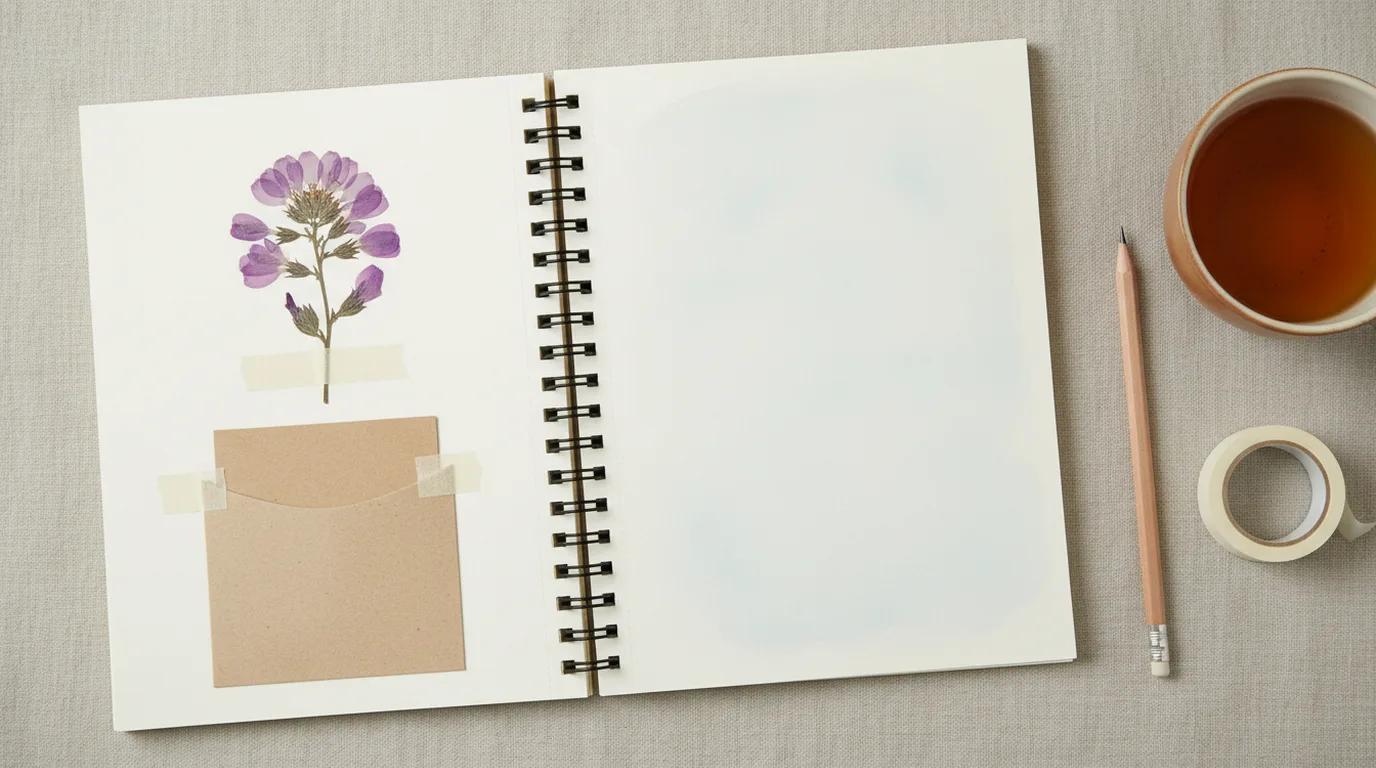
- Envelope pocket. Glue an opened envelope to a page and keep receipts, tickets and notes inside. Write the dates on the front.
- Fold-out page. Tape an extra sheet to the edge so it folds out. Use it for a longer list, a map, or anything that won't fit one page.
- Hidden flap. A smaller piece of paper taped along one edge over an entry, for the part you'd rather not have open on the desk.
- Pressed-flower page. Press something from a walk between two sheets of baking paper, then tape it in with the place and date.
- Ticket-stub timeline. Line up stubs from a year of films, concerts or trains and write one line under each.
Thinking pages that pay off later
These ideas take a little more effort and give back the most when you reread them, because they record what you thought before you knew how things turned out.
- Decision journal. Write down a decision, the options, what you expect to happen, and how sure you are. Revisit in three months. The gap between what you expected and what happened is the most honest feedback a journal gives.
- Predictions page. Five predictions for the next year about your own life, each with a confidence level. Check them next November.
- Steelman page. Pick something you disagree with and write the strongest case for it, as if you believed it. Then one line on where you still stand.
- Idea dump. Every half-formed idea, with no obligation to act on any of them. Different from a brain dump, which is about clearing worries and tasks; this one is for possibilities.
- Dream fragments. Whatever is left of a dream when you wake up, even a single image. A dedicated dream journal covers how to make the fragments last longer.
- Unsent letter. To someone you can't or won't send it to. The point is to say it fully once, on paper.
How to choose journal ideas that last
Most of these pages get started; fewer get continued. Abandoned notebooks tend to share a pattern: too many collections opened in the first week, each of which then needs feeding. A journal with twelve half-filled lists feels like a backlog.
A better rule is one quick page plus one recurring page. The quick page (ideas 1–8, 23–29) gets you writing tonight. The recurring page (ideas 9–15, 35–36) gives you a reason to open the notebook next week. Add a second recurring page only when the first has been going for a month.
Two tests help with choosing. The reread test: would you enjoy reading this page in a year? Overheard lines and "what things cost" pass easily; a page of today's tasks usually doesn't. The ten-minute test: can one entry be done in ten minutes? Ideas that need an afternoon of supplies get saved for "later" and never happen.
Gratitude pages are a useful example of why depth beats volume. UC Berkeley's Greater Good Science Center suggests writing up to five things, choosing depth over breadth, and writing about people rather than things, three times a week for at least two weeks. The same principle applies to every collection here: one well-described entry is worth more than ten names on a list.
For a sense of which journal ideas fit which way of journaling overall, our overview of the types of journaling pairs each style with who it suits.
Journal ideas for a digital journal
Most of these work on a screen too, sometimes better. Lists, collections and decision logs are easier to search later in typed form, and photos replace pressed flowers and ticket stubs well enough. Art pages are harder on a laptop and more natural on a tablet with a stylus.
In 3 Pages Daily, each day opens to three dated pages, which happens to suit the "one quick page, one recurring page" rule: a "currently" list on page one, a running collection on page two, and the third left free. The drawing canvas handles colour-of-the-day swatches and quick sketches, and on iPad the Apple Pencil draws while a finger scrolls. Grid and dotted paper styles are there for anyone who likes structure under their lists.
Start with two pages
A notebook fills up one page at a time, and the first page only has to be easy. Choose a quick idea for tonight and a collection you'd enjoy rereading, and leave the rest of this list for later.
If you'd rather answer a question than fill a page, start with what to write in a journal, which is organised by the kind of day you've had.

Camille Laurent
My journal is part notebook, part sketchbook, and part memory box for the details I want to keep.
Frequently asked questions
A junk journal is a handmade notebook built from paper that would otherwise be thrown away: envelopes, receipts, packaging, old book pages, ticket stubs. The pages become a base for collage, pockets and short notes. It sits between a scrapbook and an art journal, and it suits people who keep paper scraps from their week and want somewhere for them to live.
Concrete ones: a conversation you keep replaying, a meal worth remembering, the room you're sitting in, a decision you're half-way through, something you changed your mind about. A topic works when it points at one specific thing. Broad themes like "my life" or "relationships" stall, while "the last text I didn't answer" gets a first sentence on the page.
Start with a page that is quick and easy to fill: a list of ten things, a "currently" page, or a map of your street. Quick wins break the spell of the blank first page. After that, add one recurring page, such as a quote collection or a weekly highlight, so the notebook has a reason to be opened again next week.
An art journal is a notebook where images carry as much of the entry as words do. Pages can mix paint, collage, sketches, stamps and handwriting. Skill matters less than habit: a single colour swatch with a sentence about the day counts. Mixed-media paper or a sketchbook with heavier pages holds paint better than a standard lined notebook.
Change the format before changing the topic. Write a day as a list, a map, a recipe, a letter, a set of headlines, or a drawing with labels. A new shape makes familiar material feel new and pulls out details a paragraph would skip. Adding one physical object per week, such as a receipt or leaf, also helps.
Specific, dated details that fade fastest: what people said, prices, the weather, songs that were playing, what was on the table. Add ticket stubs or photos where you can. A line like "Mum laughed at the bread that collapsed" will mean more in ten years than a summary of the whole weekend.
One or two per sitting, plus at most three recurring pages running in the background. A notebook with fifteen half-started collections feels like homework and gets abandoned. Pick the recurring pages you'd actually reread, keep them going for a month, and swap one out only when it stops getting filled.