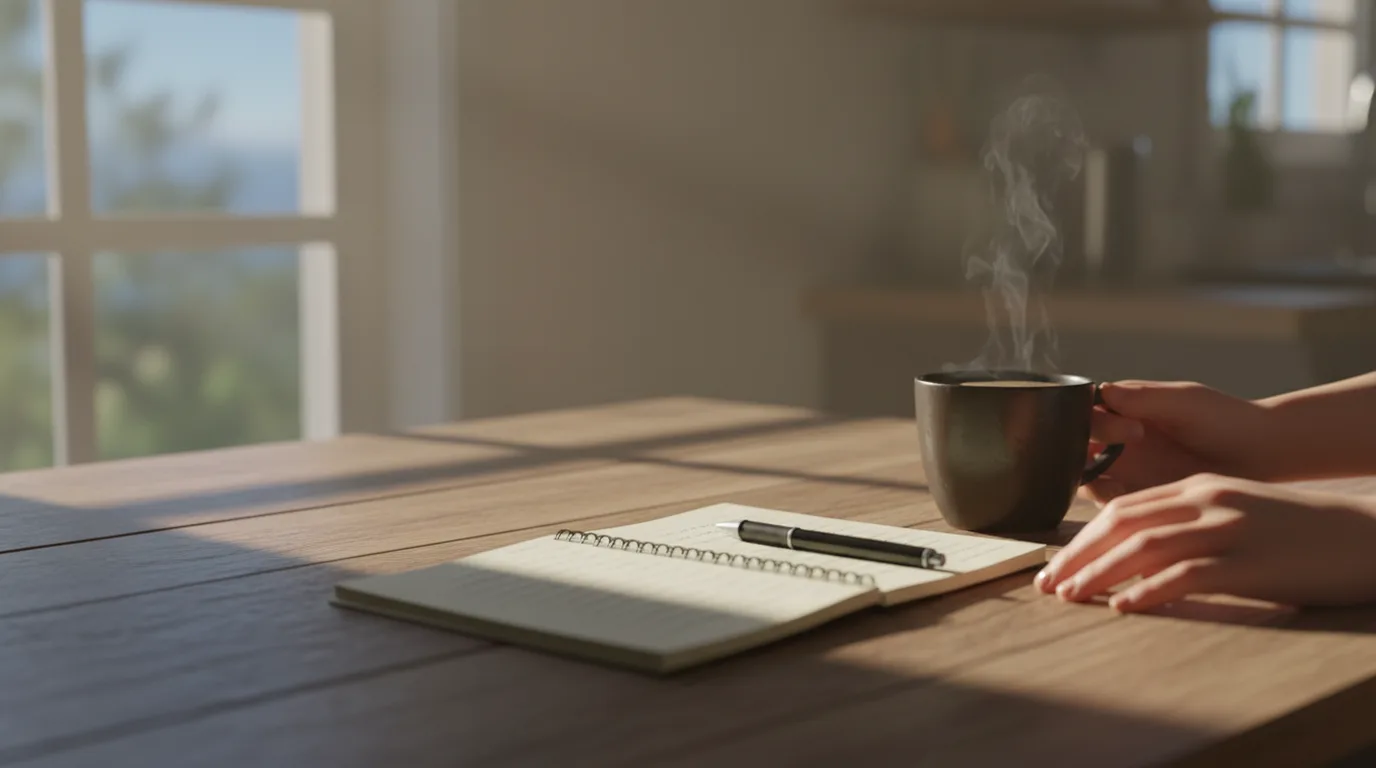

Mornings are short on time and long on noise. Before the first coffee is finished, there's a phone with notifications, a list of things due today, and whatever was left over from yesterday still running in the background. A morning journal gives that noise somewhere to go for five minutes, so the day starts with one clear thought instead of twenty half-finished ones.
The trick is asking the right question at 7am. The morning journal prompts below are short on purpose: each one is answerable before you're fully awake, and each one points toward the day ahead rather than back over your whole life.
Quick answer
Good morning journal prompts do one of three jobs: clear your head, set an intention for the day, or notice something good. Pick one prompt from the group that fits how you woke up, write for five to ten minutes, and stop. On slower mornings, the morning pages starters at the end open a longer, unedited entry.
There are 60 morning journal prompts here in five groups of 12. Use one per morning. If an entry keeps going, let it.
Morning journal prompts for clearing your head
These come first because most mornings start cluttered. The goal is to get what's already in your head onto the page before anything new arrives. If a full brain dump is what you need, our guide to the brain dump covers that method on its own.
- What's already on your mind, before you've checked anything?
- List every task rattling around your head. Don't sort it yet.
- What do you remember from your dreams, even a fragment?
- What's one thing from yesterday you're still carrying?
- What conversation are you rehearsing in your head?
- Which thought has shown up first thing more than once this week?
- What can wait until tomorrow?
- Describe the noise in your head in three words.
- What would you write if nobody would ever read this page?
- What are you avoiding thinking about this morning?
- How did you sleep, honestly, and how will that shape today?
- What does the room sound like right now?
Morning journal prompts for setting an intention
Once the clutter is out, there's room to decide what today is for. Keep these concrete. "Be productive" isn't an intention; "send the proposal before lunch" is.
- What's the one thing that would make today feel worthwhile?
- How do you want to feel at 6pm?
- What's on today's calendar, and which part are you walking into tired?
- Which task would you most like to have finished by lunch?
- Pick one word to carry through today. Why that word?
- Where is today likely to go sideways, and what will you do when it does?
- Who deserves your full attention today?
- What's one thing you'll say no to today?
- What would a calm version of today look like, hour by hour?
- What does "done" mean for today?
- What small promise to yourself can you keep before noon?
- What's one thing you'll do today purely because you enjoy it?
Gratitude prompts for the morning
Gratitude writing works best with detail. The Greater Good Science Center at UC Berkeley suggests writing up to five things you're grateful for, going into depth on each rather than making a long list, and focusing on people more than things. That's the shape these prompts follow. For a full practice built around it, see our gratitude journal guide.
- Who made yesterday easier, and what exactly did they do?
- What's something in this room you'd miss if it were gone?
- Name up to five things you're glad about this morning, with one detail each.
- Who haven't you thanked yet?
- Which part of your morning routine do you actually like?
- What went right yesterday that you didn't plan?
- Which sound, smell or view this morning is worth a sentence?
- What feels good in your body right now?
- Who are you looking forward to seeing today?
- What's a recent kindness from a stranger?
- What do you have now that you'd have wished for five years ago?
- What's quietly working in your life right now?
The Greater Good guidance also suggests a regular time and about 15 minutes, at least three times a week. Morning is a natural fit for that, because it's the slot least likely to be taken by something else.
Morning prompts for energy and the body
Some mornings the most useful question isn't about plans at all. It's about how much you have to work with today.
- Where's your energy from 1 to 10, and what's behind the number?
- What does your body want first: water, movement, food or quiet?
- Which part of you feels tense, and has it been there since yesterday?
- When will you take a break today, and what will it be?
- What would a good night's sleep tonight take?
- What did you eat yesterday that helped, and what didn't?
- How will you move today, even for ten minutes?
- Which meeting, errand or chore could be smaller today?
- Breathe slowly three times, then write what changed, if anything.
- Are you rushing this morning? What's the rush for?
- When do you usually lose focus, and what could you set up for it now?
- What would rest look like today, in one sentence?
Morning pages prompts
Morning pages are three pages of longhand, stream-of-consciousness writing done first thing after waking, described by Julia Cameron in The Artist's Way. Strictly speaking, they don't use prompts. You write whatever comes, without stopping or editing, until the three pages are full. In practice, a sentence starter helps on mornings when the first line won't come, and once you're moving, you drop it.
- "Right now I'm thinking about…"
- "The thing I keep not writing about is…"
- "This morning feels like…"
- "If I could change one thing about this week…"
- "I'm annoyed that…"
- "Something I noticed yesterday was…"
- "I want to remember…"
- "With a free hour today, I'd…"
- "The truth about this project is…"
- "I keep wondering whether…"
- "Lately I've been…"
- "Before I stop, one more thing…"
The mechanism behind morning pages is the same one behind freewriting: because you're not allowed to stop, you can't stop to judge, and the inner editor that usually filters every sentence gets left behind. That's why the second page is often more honest than the first.
How long a morning journal entry should take
Five to ten minutes is the realistic window on a weekday, and it's enough for one prompt and a full paragraph. Morning pages are the long version: three handwritten pages is roughly 750 words and usually takes 20 to 40 minutes.
Choose the length you can repeat on your busiest morning, not your slowest one. A five-minute habit that survives a Monday does more than a forty-minute ritual that only happens on Sundays. And if a morning gets away from you, two lines still count as an entry.
Morning or evening journaling?
They answer different questions. Morning writing tends toward intention: what's on your mind and what you want from the day. Evening writing tends toward accounting: what happened and what it meant. Neither is better. If you also write at night, our 120 journal prompts sorted by mood include an end-of-day set that pairs well with these.
The best time is the one you'll keep. For most people, that means tying the entry to something that already happens every morning, like the kettle, the first coffee or the train.
Where to write in the morning
Friction is the enemy at 7am. The fewer steps between waking up and writing, the more often it happens. A notebook that stays open on the kitchen table works. So does a page that's already waiting.
That's the idea behind three pages a day in 3 Pages Daily: three blank pages open every morning, filed by date, with no folders or templates to set up. It keeps the morning pages rhythm without requiring longhand, and you can type, sketch, or record a voice note on mornings when talking is easier than writing. Our iPhone, iPad and Mac app does the same on your devices, behind a four-digit passcode.
Start tomorrow
Three things to take into tomorrow morning: one prompt is enough, five minutes is a full session, and the group you pick should match how you woke up. Clear your head on cluttered mornings, set an intention on busy ones, and notice something good on the rest. Pick tomorrow's prompt tonight, and the hardest part of the morning is already done.

Ethan Morales
Work, family, and good ideas rarely arrive one at a time, so I'm interested in capturing what matters before it disappears.
Frequently asked questions
Start with whatever is already in your head, then point it at the day ahead. A simple shape works: one line clearing out a worry or task, one line naming what would make today worthwhile, and one thing you're glad about. Morning journal prompts help when nothing comes, because they ask one small question instead of asking you to sum up your life before breakfast.
Morning pages are three pages of longhand, stream-of-consciousness writing done first thing after waking, described by Julia Cameron in The Artist's Way. The point is not to produce anything good. It's to clear whatever is sitting at the front of your mind before the day starts. Three handwritten pages usually take 20 to 40 minutes.
Five to ten minutes covers one prompt and a full paragraph, which is enough for most mornings. Morning pages take longer, often 20 to 40 minutes for three pages. Pick the length you can repeat on a busy weekday rather than the one that fits a slow Sunday. A short habit you keep beats a long one you drop after a week.
They do different jobs. Morning entries lean toward intention: what's on your mind and what you want from the day. Evening entries lean toward accounting: what happened and what it meant. Many people do both, briefly. If you can only pick one, choose the time you're least likely to skip, then use prompts that suit that time.
Try "What's already on my mind, before I've checked anything?" followed by "What can wait until tomorrow?" The first gets the worry onto the page; the second sets one thing down. Keep the entry short and end on the day's first concrete step. If anxiety is making mornings hard most days, a doctor or licensed therapist is worth talking to.
You can, and plenty of people do. Julia Cameron recommends longhand, and handwriting does slow you down in a way some writers value. Typing is faster, so three typed pages hold more words and take less time. What matters most is the rule underneath both: write continuously, don't edit, and don't reread until later.
Write that. "I have nothing to say this morning" is a legitimate first line, and continuing to write past it is the whole exercise. Describe the room, list what's on today's calendar, or use a sentence starter such as "Right now I'm thinking about…". Within a page, the writing usually finds something it wanted to say.