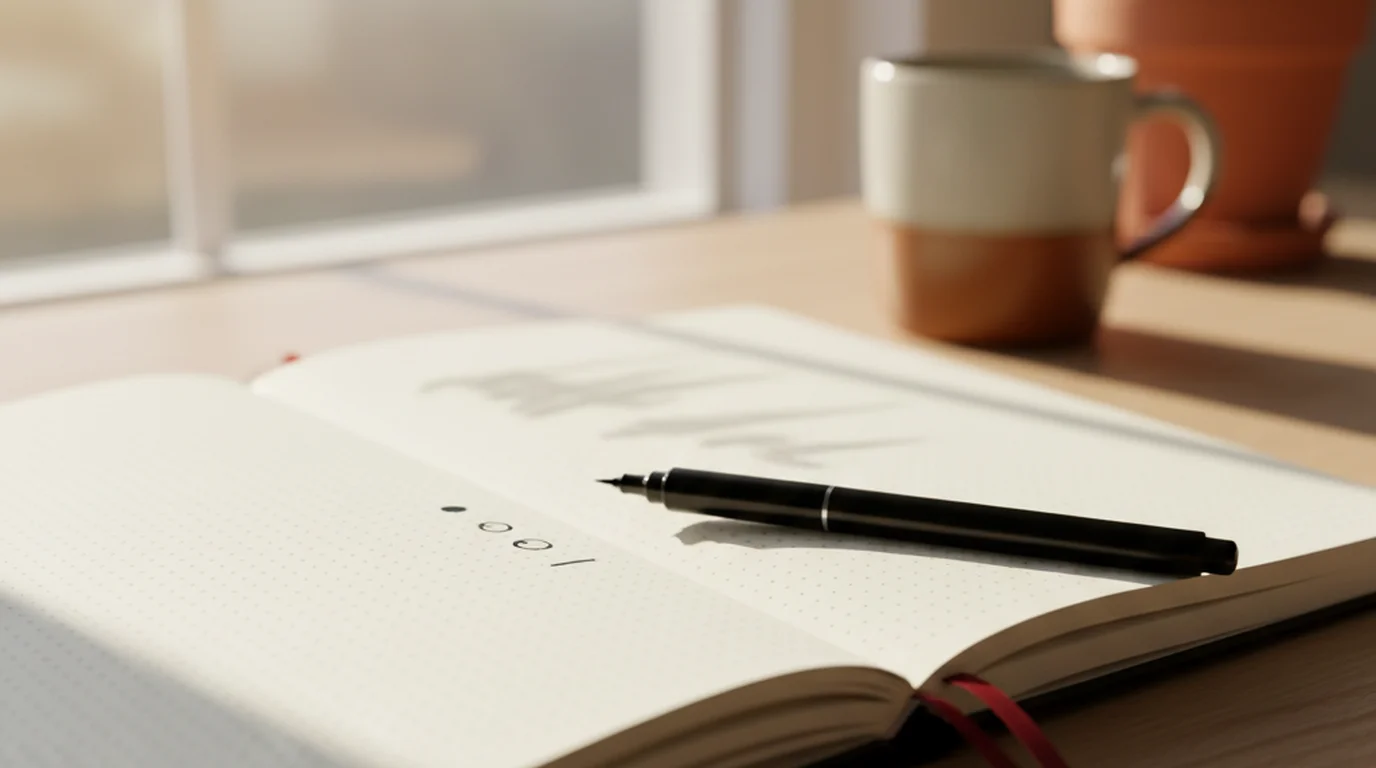

Morning pages are three pages of writing done first thing after you wake up, about anything at all, without stopping to edit. They come from The Artist's Way, Julia Cameron's 1992 book on creative recovery, and they've outlived most other productivity habits because they ask for so little: a notebook, a pen and the half hour before the day gets loud. Writers use them to get unstuck, managers to clear their heads before meetings, and plenty of people simply to stop thinking in circles.
Quick answer
Morning pages are three pages of longhand, stream-of-consciousness writing done right after waking. Write whatever comes into your head, keep the pen moving, skip editing, and don't reread them for the first few weeks. Three pages is about 750 words and takes 20 to 40 minutes by hand.
What are morning pages?
Morning pages are a daily writing practice with three fixed rules: write three pages, write them first thing in the morning, and write whatever is there, without censoring it. Julia Cameron describes them in The Artist's Way as the first of two core tools in her 12-week program (the second is the "artist date," a solo weekly outing).
What makes morning pages different from ordinary journaling is that nothing about them is meant to be good. Grocery lists, complaints about sleep, a half-remembered dream and the email you're dreading all count. Cameron's framing is that the pages drain the mental noise, the repetitive worries and self-criticism, before it can follow you into the work you actually care about.
The other defining feature is privacy. Morning pages are written for no one, including your future self, at least for the first stretch. That's why they work for people who freeze in front of a journal prompt: there's no question to answer well.
How to do morning pages: the first week
The method takes a minute to explain and a week to settle in. Here's a plan for the first seven mornings.
1. Set up the night before. Leave the notebook open on the table, or keep the three pages for today one tap away on your phone. The fewer decisions between waking up and writing, the more mornings you'll actually start.
2. Write before anything else. Before the phone, the news and the inbox. Coffee is fine. The point is to reach the page while your mind is still running on its own material rather than on other people's.
3. Fill three pages without stopping. If nothing comes, write "nothing comes" until something does. Keep the hand moving. Spelling, grammar and logic are all optional. This is the same rule as stream of consciousness writing: the moment you start editing, you start censoring.
4. Stop at three pages. Not at a good thought, and not after you've "finished." The fixed length is what makes the habit sustainable on bad mornings and keeps it from swallowing good ones.
5. Close the notebook without rereading. Cameron asks you to leave the pages unread through the early weeks of the program. In our experience, this is the rule people most want to break and the one that matters most early on.
6. Expect the second page to be harder. The first page empties out what's on top: tasks, weather, sleep. Page two is where the writing often stalls, and page three is where something unexpected tends to surface. Pushing through that stall is the whole exercise.
7. Count weeks, not mornings. Missing a day doesn't reset anything. Most people need two to three weeks before the pages start to feel like a release rather than a chore.
Why three pages, and why first thing?
Three pages is roughly 750 words, the same daily target 750 Words built its site around. The length matters because the first few hundred words are reliably shallow. A one-paragraph check-in rarely gets past "tired, busy, need to call the bank." Three pages force you through that layer and into what's underneath it.
Morning matters for a related reason. Right after waking, the mind hasn't yet been filled with other people's priorities. Writing then captures your own agenda before the day replaces it with somebody else's, and it puts the worry that would otherwise hum in the background all day somewhere you can see it.
The research behind morning pages is indirect but encouraging. The closest studied practice is expressive writing, where people write about their thoughts and feelings for short sessions. James Pennebaker's 2018 review in Perspectives on Psychological Science describes the standard protocol as 15 to 20 minutes of writing over three to five sessions, and notes that in the original 1986 experiment, students who wrote for four days visited the campus health center about half as often over the following months as the control group.
A broader 2022 meta-analysis of 20 randomized trials, published in Family Medicine and Community Health, found journaling reduced mental health symptom scores by about 5% more than control conditions. The authors call it a useful complement to care rather than a replacement. Morning pages are longer and more frequent than those protocols, so the honest summary is this: the mechanism is well supported, and the specific three-page format is supported mostly by the experience of the people who keep it up.
Longhand, typed or spoken?
Cameron asks for morning pages to be written by hand. Handwriting is slower than thought, which stops you from skimming the surface, and there's no backspace to tempt you into editing.
In practice, the habit you keep beats the method you abandon. Three adaptations hold up well:
| Format | Time for three pages | What it keeps | What it changes |
|---|---|---|---|
| Longhand in a notebook | 20–40 minutes | The original method in full | Hard to find old pages later |
| Typed | About 19 minutes at 40 wpm | The length, the timing and the no-editing rule | Faster, so the writing can stay on the surface |
| Handwritten on a tablet | Similar to paper | The pen-in-hand feel | Pages are dated and searchable |
Speaking is the outlier. Dictating 750 words takes five to seven minutes, which makes it useful on mornings with no time, but it loses the slowness that gives the practice its depth. Treat spoken pages as a backup, not the default.
If you want the digital version, a morning pages app that opens to three blank, dated pages removes the setup step entirely. 3 Pages Daily is built around exactly that unit: each day starts with three empty pages filed under the date, with Apple Pencil handwriting on iPad, typing everywhere, and voice notes for the rushed mornings.
Common problems in the first month
"I don't have 30 minutes." Start with one page for the first week and add a page each week. The habit matters more than the length at first. Getting up 20 minutes earlier for a month is usually easier than finding 20 minutes later in the day.
"I keep writing the same thing." That's the pages working. Repetition shows you what's actually occupying your mind. When the same complaint appears for the tenth morning, it's often a sign to act on it rather than write about it again.
"It feels pointless." Most people hit this in week two. The shift usually comes after two to three weeks, when the pages start surfacing ideas and decisions rather than just complaints. If you need a nudge on blank mornings, a handful of morning journal prompts can get the first line onto the page.
"Someone might read them." Keep the notebook somewhere private, or use a journal with a passcode. Morning pages only work if you write without imagining a reader.
Start tomorrow morning
Morning pages ask for three things: three pages, first thing, no editing. Everything else, including paper versus screen, the exact time and what you write about, is flexible. Give the practice three weeks before judging it, leave the pages unread for the first month, and push through page two on the mornings it stalls.
Tonight, put the notebook where you'll see it when you wake up, or download the free 3 Pages Daily app for iPhone, iPad and Mac so tomorrow's three pages are already waiting.

Camille Laurent
My journal is part notebook, part sketchbook, and part memory box for the details I want to keep.
Facts and pricing in this article were last verified on November 18, 2026.
Frequently asked questions
Doing morning pages means writing three pages by hand as soon as you wake up, about whatever is in your head, without stopping to edit or reread. The practice comes from Julia Cameron's The Artist's Way. The pages are private, and their job is to empty the mind of noise so the rest of the day starts clearer.
Most people who keep them for a few weeks report a quieter head and clearer priorities, and the practice is close to expressive writing, which has decades of research behind it. Pennebaker's 2018 review describes reliable benefits from 15 to 20 minute writing sessions. Morning pages are longer and daily, so treat the research as supporting evidence and judge the habit by your own first month.
Three pages is the rule because it is long enough to get past surface chatter: the first page tends to be complaints and to-dos, and the useful material usually turns up on pages two and three. If three pages is too much at the start, write one page for the first week and add a page a week. Keep the page count fixed rather than the clock.
Morning pages are one specific kind of journaling. Most journaling has a subject, a prompt or a purpose, and gets reread. Morning pages have a fixed length, a fixed time of day, no topic and no rereading for the first weeks. Many people keep both: morning pages to clear the mind, and an evening journal to reflect on the day.
Three handwritten pages, roughly 750 words, take most people 20 to 40 minutes. Typing is quicker: at 40 words a minute, 750 words takes about 19 minutes. The time usually drops in the second week, once the hand stops waiting for something worth writing and simply keeps moving.
Julia Cameron asks for longhand, and handwriting has a real advantage: it is slower, so the writing stays closer to your thoughts. Typed morning pages still keep the core of the method: three pages, first thing, unedited. Many people type on workdays and write by hand on weekends. On an iPad, handwriting with Apple Pencil keeps the longhand feel while the pages still file themselves by date.
In The Artist's Way, Cameron asks you to leave the pages unread through the early weeks of the program. Rereading too early turns the pages into something to perform for, which is the opposite of the point. After a couple of months, a quick read through a month of pages often shows the same worries and ideas returning, and those are worth acting on.